

A settlement has been obtained for a 17-year-old boy who lost the sight in one eye as a result of...
 |
CWJ client Nic O’Brien of Fit for Work tells us more about a typical day of treating occupational injuries and how to prevent them.
I am from a South London local company based in Crystal Palace, called Fit for Work. We are an award winning specialist Occupational Physiotherapy provider. We work with public and private sector organisations to reduce their musculoskeletal disorders (MSD) workplace absence by helping their Employee’s to be healthier, fitter and more productive.
Musculoskeletal disorders (MSDs) such as back and neck pain, are one of the biggest causes of sickness absence on any given day and account for nearly a third of the total time taken off sick from work. Yet they are also easy to address with low cost and effective Physiotherapy interventions. Each person with a musculoskeletal disorder (MSD) takes an estimated 17.2 days off work on average. MSDs are estimated to cost society and employers around £7.4 billion a year.
We provide complete return to work solutions for MSD Conditions. We are a specialist service in assessing, treating and rehabilitating Employees back to work and function through a bio psychosocial approach, in the safest and quickest possible time.
A typical day for one of our physiotherapists involves;
- Seeing 8-12 patients for physiotherapy assessment and treatment – Our most common complaints are those of the lower back, neck, shoulder and upper limb.
- Our physiotherapists have special training in work station ergonomics, manual lifting and handling and risk management and they utilise these skills on a daily basis
- A large part of Occupational Health Physiotherapy is feeding information about the employee’s working functional capacity back to managers to allow the manager to support the employee at work during their recovery.
Here are some practical tips on how to avoid potential MSD problems:
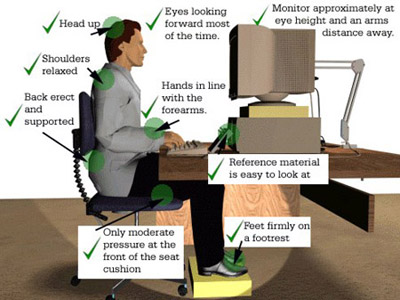
- Adjust your chair and monitor to find the most comfortable position for your work. As a broad guide, your forearms should be approximately horizontal and your eyes the same height as the top of the monitor
- Adjust your keyboard to get a good keying position. Try to keep your wrists straight when keying. Keep a soft touch on the keys and don’t overstretch your fingers. Good keyboard technique is important.
- Be aware of posture and breaks - Don’t sit in the same position for long periods. Make sure you change your posture as often as practicable. Frequent short breaks are better than fewer long ones
 |
In 2011 Fit for Work we were voted Best Physiotherapy Service in the UK by the Chartered Society of Physiotherapy and in 2013 won the South London Business Award for Best Customer service. In both 2013 and 2014 we were named in the Sunday Times Top 100 Companies to Work For.
For further information contact Nic O’Brien at: n.obrien@fitforworkuk.co.uk